Most people only check the temperature. That's not the whole story.
The Window Cooling Calculator app (WindowCooling) compares the indoor and outdoor enthalpy — a calculation that factors in humidity as well as temperature — to tell you when opening your windows will genuinely cool and dry your home for free.
Free cooling is standard practice — just not in your house
When deciding whether it's worth opening the windows, most people just compare indoor and outdoor temperature. But humidity matters too. HVAC systems in large commercial buildings and condominiums already do this: they compare the enthalpy — the total heat energy, combining temperature and humidity — of indoor and outdoor air, and pull in outside air as free cooling instead of running the AC. In many climate zones, this is required by energy-efficiency codes such as ASHRAE 90.1.
The vast majority of HVAC systems in single-family homes don't do this. WindowCooling brings that same engineering practice to your home, so you can make an informed decision about your own windows.
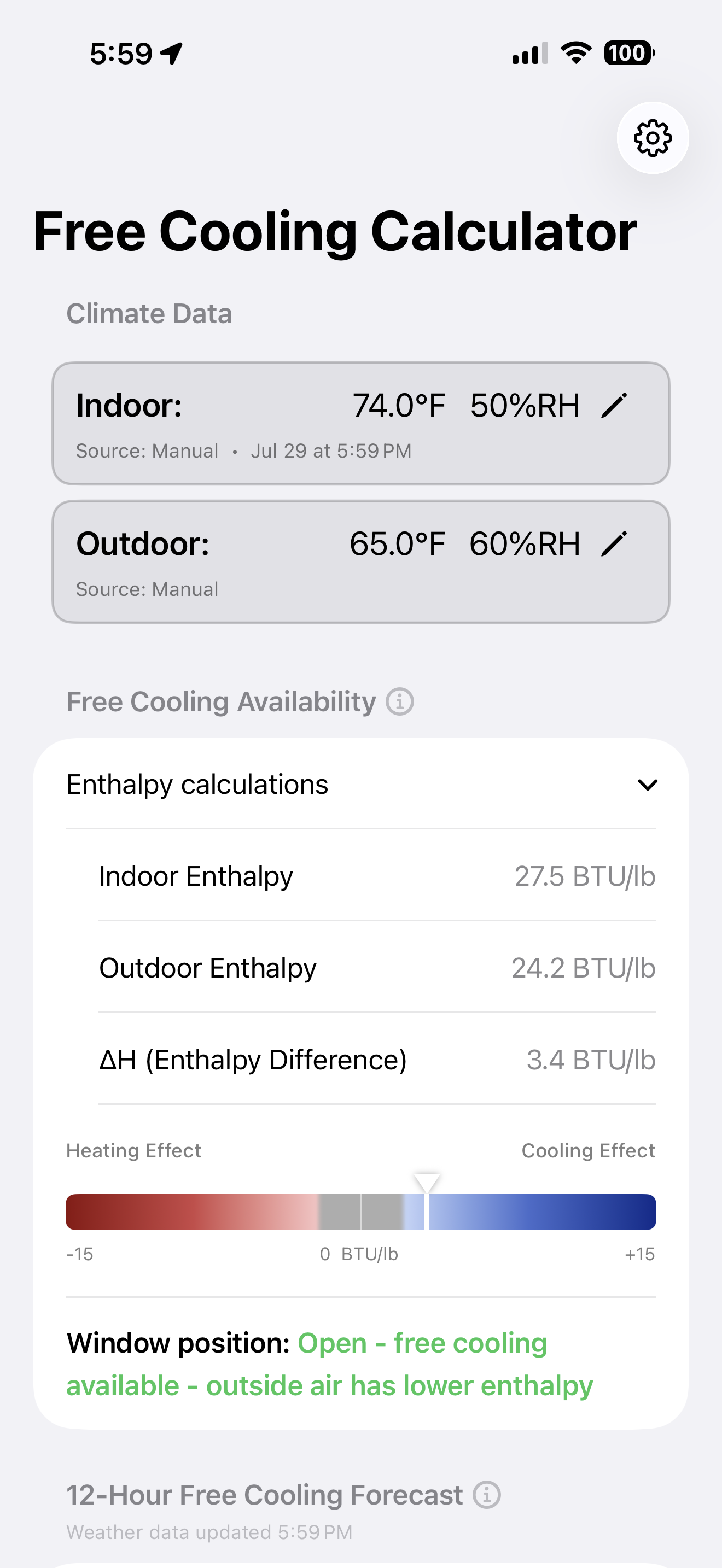
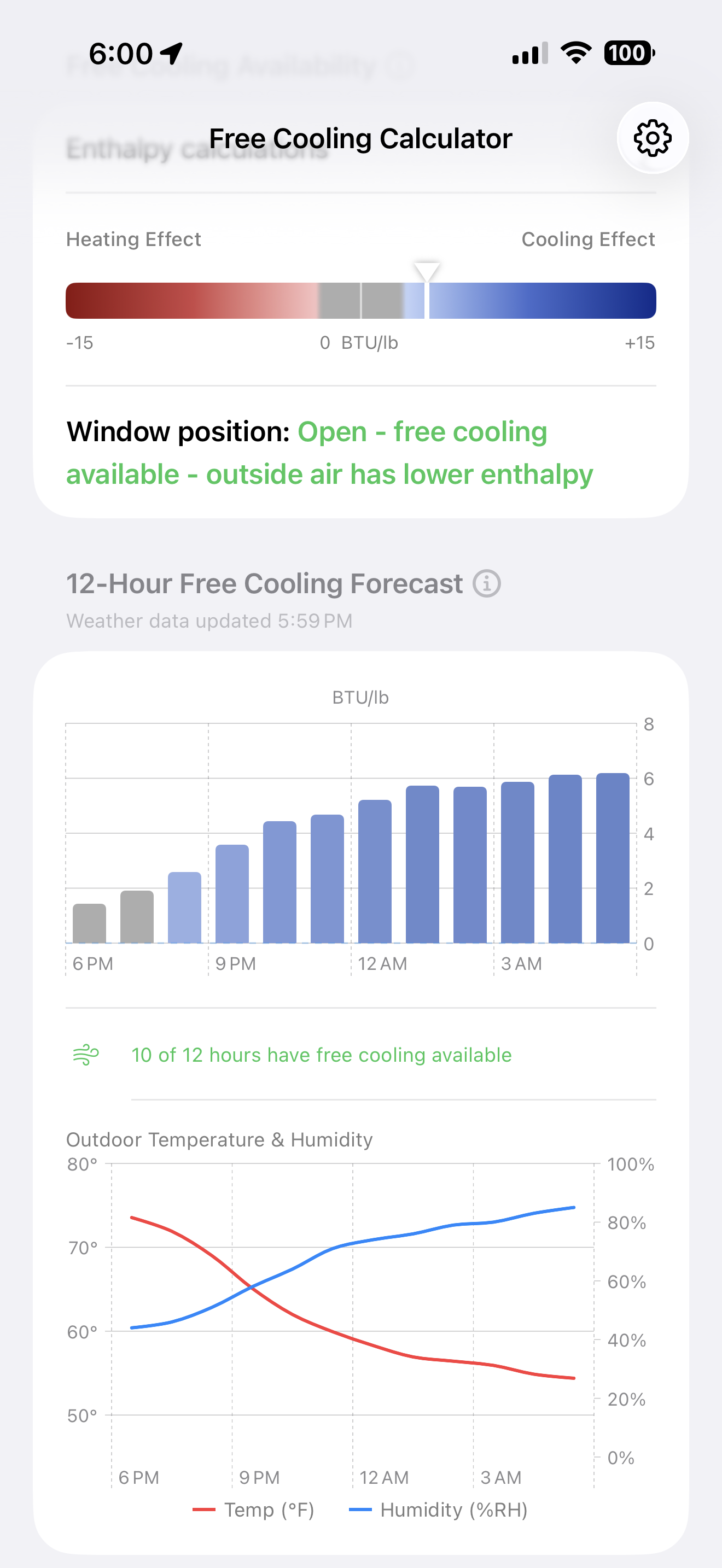
See it in action
WindowCooling calculates the enthalpy difference between your indoor and outdoor air, tells you whether to open your windows right now, and forecasts free cooling availability for the next 12 hours.
Getting your data in
WindowCooling needs the temperature and humidity of the air indoors and outdoors. There are a few ways to provide it:
Your thermostat or weather station
If you already have a Nest, Ecobee, or similar smart thermostat, consult it for the indoor temperature and humidity and enter them manually. If you have a weather station that gives you indoor and outdoor temperature and humidity, you can enter both sets of data manually.
Apple Weather
For outdoor conditions, WindowCooling can query Apple Weather using your location — no extra hardware required.
Govee H5074 sensors
For the most accurate readings, pair a low-cost Govee H5074 Bluetooth thermometer/hygrometer — or two, one indoors and one just outside your window. Support for more sensors is planned.
Why WindowCooling
Enthalpy, not just temperature
A cool, humid day can carry more heat energy than a warmer, dry one. WindowCooling compares total heat content, so its recommendation is right even when a thermometer would mislead you.
A 12-hour forecast
Don't just check now — see how many of the next 12 hours will actually offer free cooling, so you can plan ahead.
Saves Money
A typical whole-house central air conditioner uses 3,000 to 5,000 watts per hour of continuous operation. The average cost for electricity in the US is 18.83 cents per kilowatt-hour (kWh). So running a 4,000 watt per hour AC for 8 hours a day at that rate would cost about $6.00 per day. Save that money by using free cooling when possible.